Resources

National PTA Resources

Need content…

National StandardsSuccessful Family-School Partnerships

PTA’s process for building successful partnerships starts with the National Standards for Family-School Partnerships and consists of three steps:

  • Raising awareness about the power of family and community involvement.
  • Taking action to cultivate involvement through specific programs and practices.
  • Celebrating success as your school sees increased involvement and its impact. 

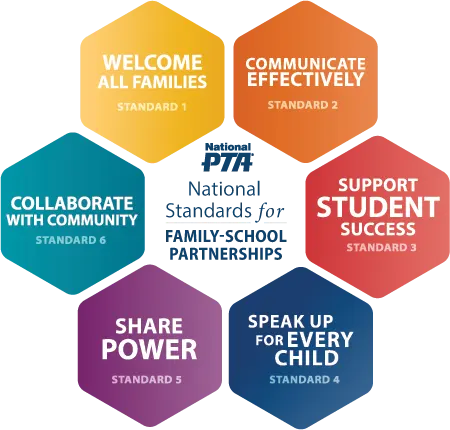
PTA’s National Standards for Family-School Partnerships

Standard 1: Welcoming All Families into the School Community 
Families are active participants in the life of the school, and feel welcomed, valued, and connected to each other, to school staff, and to what students are learning and doing in class.

Standard 2: Communicating Effectively
Families and school staff engage in regular, two-way, meaningful communication about student learning.

Standard 3: Supporting Student Success 
Families and school staff engage in regular, two-way, meaningful communication about student learning.

Standard 4: Speaking Up for Every Child
Families are empowered to be advocates for their own and other children, to ensure that students are treated fairly and have access to learning opportunities that will support their success.

Standard 5: Sharing Power
Families and school staff are equal partners in decisions that affect children and families and together inform, influence, and create policies, practices, and programs.

Standard 6: Collaborating with Community 
Families and school staff collaborate with community members to connect students, families, and staff to expanded learning opportunities, community services, and civic participation.​​​​​​​  

For more information about the National Standards and PTA programs that promote family-school partnerships, visit National PTA

Be the first to hear about National PTA’s advocacy efforts, grant opportunities and parenting advice.

Weekend Update
Get weekly updates with announcements, offers, deadlines and grant opportunities!

Leadership Briefing
Receive monthly updates with the latest PTA programs, resources and leadership training!

Advocacy Insider
Receive monthly news about legislative issues affecting education, National PTA’s policy priorities and activities!

Our Children Magazine
Get the latest parenting, wellness and family fun articles from National PTA’s magazine!

Our ChildrenThe Unique Voice for Parents

Our Children Magazine is the unique voice for parents, published by National PTA, created for the parent who’s always on the go and looking for the best info to help their child excel at school and in life. Topics in Our Children Magazine include:
  • Parenting
  • Education
  • Wellness
  • ​​​​​​​Family Fun
  • PTA In Action

Forms/Guides Library

Helpful forms and guides to support your PTA’s success!

Finance GraphicDid You Know?

  • All monies deposited into a PTA account will be considered PTA funds by the IRS.
  • A PTA should never deposit school or school-related money into its account.
  • PTA’s do not share their EIN number with their school or sales tax exemption, they are completely separate.

Budgets:

  • A budget shows a plan for how your PTA will raise money and spend money to implement the PTA mission.
  • A budget does not dictate what your PTA must do. It simply represents what your PTA intends to do.
  • A finance or budget committee usually has the responsibility of developing a budget for the PTA.
    • This committee may be elected or appointed according to the PTA bylaws and usually consists of three or five members, one of whom is the treasurer, who may act as chair.
    • This is important because it doesn’t allow the officers to dictate the budget.

Banking:

  • Have bank statements sent to the school.
  • Have a non-signer go over the bank statements and initial (now a requirement for most insurance).
    • Principal is a smart choice.
  • Two signatures on all checks.
  • Always present a Treasurers Report at every monthly PTA meeting.  
  • Bring bank statements to monthly meetings so PTA members can review if necessary.
  • Reconcile bank statements every month to make sure all financial transactions are documented.
  • Maintain all financial records in a binder with electronic back-up.

Fundraiser GraphicFundraising:

As PTAs work to move their mission forward and serve the children in our schools, they often find that dues are not sufficient to achieve their mission to make every child’s potential a reality.

Fundraising is a necessary component to provide the means, yet it can be challenging.

Key points to remember:

  • All PTA fundraising should support PTA’s mission, in both how the funds are raised and how they are spent.
  • Adults should raise PTA funds. PTAs are strongly encouraged to avoid activities that require children to sell to strangers.
  • Transparency is key. The ways in which funds are raised and spent should be communicated clearly to members and the school community as a whole.
  • All funds generated by a PTA, including the local portion of dues, should be budgeted for purposes that advance PTA work, such as enhancing student success or improving the school.
  • Fundraising activities themselves should be conducted in alignment with the PTA mission.

Begin each year with specific, mission-driven goals in mind.
Identify strategies for reaching those goals before determining the dollar amount needed from fundraising events. They should raise only the funds necessary to meet the needs of the year’s activities and projects, as outlined in the PTA’s budget. In keeping with our mission, National PTA encourages local PTAs to utilize fundraisers in which only adults, not children, are active as fundraisers.

Know the laws.
Your PTA must follow federal and state laws to maintain your tax-exempt status with the IRS. Review the legal implications of fundraising. For example, your PTA should not provide financial assistance to an individual or family in the case of a catastrophic event, such as a fire or other disaster. While these efforts are well-intentioned, it could result in losing your PTA’s tax-exempt status.

Transparency is key.
The ways in which funds are raised and spent should be communicated clearly to members and the school community as a whole regularly and in multiple ways.

OTHER HELPFUL FORMS:

Local PTA Toolkit

Need content…